Sep 22, 2026 12:26 PM
Hyde Park Jazz Fest on Chicago’s South Side to Present 20th Edition
The Hyde Park Jazz Festival will take place for the 20th time on the final weekend of September 2026. Beginning half…


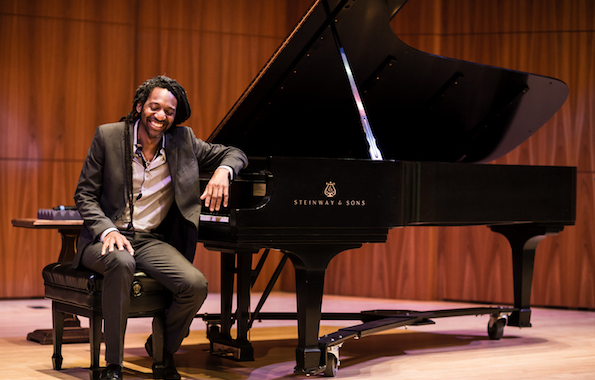
Elio Villafranca has recorded his sixth album, Cinqué.
(Photo: Tomas Flint)For five days in early May, Cuban pianist/composer Elio Villafranca set up shop at Systems Two, the state-of-the-art recording studio in Brooklyn, to record his sixth album, Cinqué (ArtistShare). The program, which includes five movements, contains music he had performed onstage at Jazz at Lincoln Center in 2015.
The disc’s title refers to Joseph Cinqué (1814–’79), the West African man who led a revolt aboard the ship La Amistad, which was transporting Cinqué and others who had been captured as part of the slave trade.
“Cinqué showcases,” Villafranca said, “the cultural diversity of the five Caribbean islands of Cuba, Puerto Rico, Haiti, the Dominican Republic and Jamaica, while simultaneously highlighting the African traditions woven into the fabric of each of these nations.”
On board for both the 2015 live performances and at Systems Two was an all-star ensemble: Steve Turre (trombone, conch shells), Greg Tardy (tenor saxophone, clarinet), Vincent Herring (alto sax, flute), Freddie Hendrix (trumpet), Todd Marcus (bass clarinet), Ricky Rodriguez (acoustic bass), Leyla McCalla (cello, banjo, vocals) and percussionists Jonathan Troncoso, Arturo Sable and Miguel Valdes.
Drummer Lewis Nash was the only new face to surface for the recording sessions. Later, in New Orleans, Villafranca added overdubs from Don Vappie on banjo and Leyla McCalla’s vocal for his version of the Haitian song “Messi Bondye,” while back in Brooklyn, trumpeter Wynton Marsalis provided additional overdubs. Narration was interwoven into the fabric of the music, adding some background context about the music and history of particular events.
“I carefully choose the soloist depending on a particular sound and message I want to create in the music,” Villafranca said. “In the section ‘The First Colony,’ I wanted to musically represent the first encounter between the Maroons, who were fugitive black slaves, and the few Taino or Arawak people who survived the Spanish invasion by hiding in the hills and creating the first colonies of free people. In this case, I asked Steve Turre to play the shells over the Congo derived rhythm called the salve.”
The overall vibe of the sessions at Systems Two was serious yet laced with a mix of laughter and looseness. Villafranca seemed to spend as much time behind the glass, if not more, conducting from behind the main mixing board, as he did in the studio at the piano.
Organized and flexible, with multiple tasks to attend to, Villafranca received technical support from sound engineer/studio owner Mike Marciano and Jason Olaine, Jazz at Lincoln Center’s director of programming and touring.
Early on, the sessions involved a lot of micro-management, as Villafranca tweaked small sonic details, striving to achieve the best transition, the most eloquent series of notes played, the right tempos.
In the studio, Villafranca was never at a loss for where the music should go at any given moment. He frequently gave the band members verbal directions, spoken but sometimes sung, demonstrating by using mostly non-technical language. Often, Olaine would offer suggestions, such as “an overdub at bar 86 with Vincent’s flute,” or “That tempo’s just a hair slow.” Despite the acute attention to detail, the assembled team remained focused and energized.
With Executive Producer Roberta Brenza and ArtistShare founder/CEO Brian Camelio on hand for the sessions, it became clear that Villafranca had composed this music for the group, not for himself. The artistic process was a democratic one where all voices were heard.
“Elio’s Afro-Cuban compositions and performance are quite different than Dizzy’s,” said Turre, comparing Villafranca to Gillespie, with whom the trombonist collaborated. “Whereas Diz combines swing and bebop with Cuban rhythms and melodic concepts, Elio has a strong European classical background. I’d say his take is more like Cuban, classical and swing, in that order. Since both swing and Cuban music have the same roots in African rhythms, the ‘feeling’ is always there.”
Villafranca described his overall approach: “When I’m composing I think more like a classical composer than a jazz musician, and once this first phase is done, then I consider developing a solo section, backgrounds, and what would be the best instrumentation for the music.”
Note: The album will be available via ArtistShare on March 29. DB
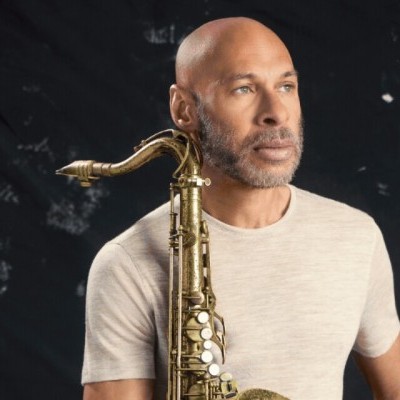
A solo concert by saxophonist Joshua Redman will close the first night of the Hyde Park Jazz Festival on Sept. 26.
Sep 22, 2026 12:26 PM
The Hyde Park Jazz Festival will take place for the 20th time on the final weekend of September 2026. Beginning half…
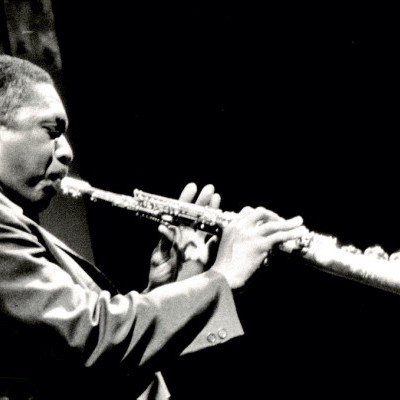
“It was just that suddenly … I could hear it,” Ravi Coltrane said of an epiphany he experienced during his late teens regarding his father’s music. “And it was almost like a calling, like something saying, ‘Hey, man, come on. It’s time to get serious.’ And the first time you really tune in and dial in and focus like that, it can be very life-changing.”
Sep 22, 2026 1:39 PM
Editor’s Note: Tomorrow, Sept. 23, is the 100th anniversary of John Coltrane’s birth. In honor of the tenor and…
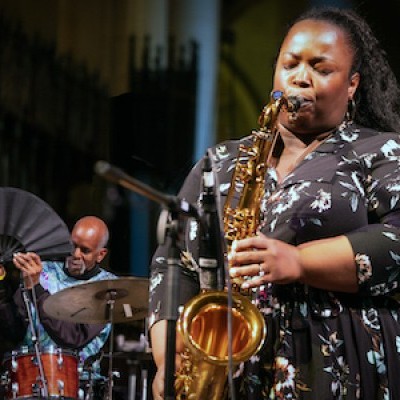
Camille Thurman took to the stage alongside bassist Kenny Davis and drummer Tommy Campbell for a rendition of Johnny Mercer’s “I’m An Old Cowhand” that recalled Rollins’ epochal 1957 trio outing Way Out West.
Oct 6, 2026 1:33 PM
As emcee Mark Ruffin noted at the commencement of an epic tribute to saxophonist Sonny Rollins at the Cathedral of Saint…
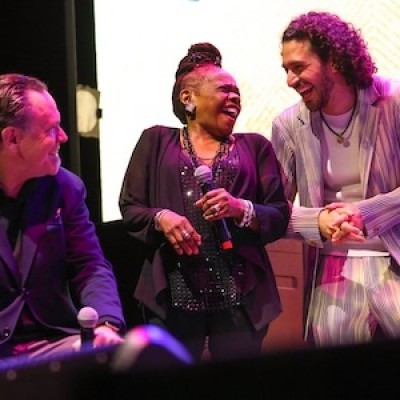
Kurt Elling, Katherine Russell and Emmet Cohen (host on the 2027 Jazz Cruise) share a laugh at sea.
Sep 8, 2026 11:52 AM
It began in 2001. A travel agent named Anita E. Berry had been booking clients on “partial” jazz cruises that took…
Sep 17, 2026 11:00 AM
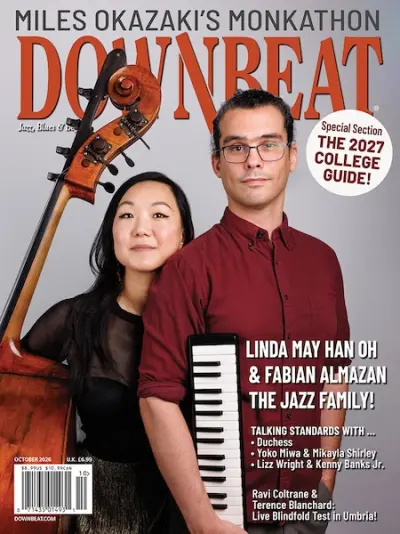
The 2027 DownBeat College Guide is an invaluable resource for music students, especially jazz students, to find a school…