Sep 22, 2026 12:26 PM
Hyde Park Jazz Fest on Chicago’s South Side to Present 20th Edition
The Hyde Park Jazz Festival will take place for the 20th time on the final weekend of September 2026. Beginning half…


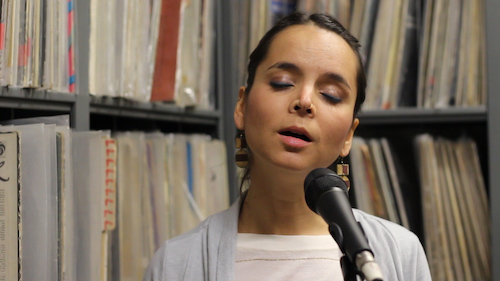
Vocalist Sara Serpa’s work has explored how past events influence current human behavior.
(Photo: Courtesy WNUR)Violence. Brutality. Segregation. Exploitation. These are the words that singer/composer Sara Serpa uses when she talks about the family legacy that she inherited—a legacy that her latest musical projects tackle head-on.
Serpa’s parents were born during the 1940s in Angola, then a Portuguese colony in Africa, and witnessed the atrocities committed against black people there. Later, after they’d moved to Lisbon—where Serpa was born—they participated in public protests against these injustices. Today, Serpa carries on her family’s commitment to social justice through her art.
“There is an absence of conversations of race in Portugal, even though Portugal has had a relationship with Africa for 500 years and was chiefly responsible for the slave trade,” Serpa said. “Having a family that lived [during that colonial period], I always asked a lot of questions about it. Racism is still very present in Portuguese society, but it’s not talked about enough.”
With one of her latest multimedia works, Recognition, Serpa opens up that conversation. The project—a pastiche of clean, melodic compositions, silent Super-8 films from the family archive and texts by African revolutionary thinkers—began in 2017 as part of a program curated by composer John Zorn at The Drawing Center in New York, where Serpa currently is based. By then, Serpa had been singing Zorn’s a cappella compositions with vocal quartet Mycale for almost four years and soon was to release Close Up (Clean Feed), her 10th album as a leader/producer. Recognition represented her first foray into directing and composing a live interdisciplinary piece; she plans to release a recording of the ongoing project in both audio-visual and audio-only formats later this year.
After the Recognition premiere, Serpa found that she still had more to say about Europe’s historical relationship with Africa and its unacknowledged pain. Earlier this year, she unveiled her second live interdisciplinary performance piece, Intimate Strangers, which melds original music with text, images and field recordings. This time she worked with Nigerian author Emmanuel Iduma, taking inspiration from his book A Stranger’s Pose, a deeply personal account of life across the African continent.
After moving to the States in 2005 to attend Berklee College of Music, and later New England Conservatory of Music, Serpa quickly gained attention for her cool, wordless vocals. Besides Zorn, she soon was working with the likes of pianist Danilo Pérez, saxophonist Greg Osby and two MacArthur Fellows—drummer/composer Tyshawn Sorey and pianist Ran Blake. But it’s hardly surprising that Serpa would attract such talents, given the gemlike quality of her instrument—and how she uses it.
“There’s something pure and fragile about her voice,” said saxophonist Ingrid Laubrock, who makes up one-third of Serpa’s regular trio (with cellist Erik Friedlander). “She uses very little ornamentation, very little vibrato. I love that about it. It’s super atypical for jazz singing, and it’s quite hard to sing that way. If you don’t bend into notes or use a lot of vibrato, you really have to hit the pitch—and that’s what she does.”
To Laubrock’s point, it would be a mistake to underestimate the vocal control that it takes to sing as Serpa does—softly, in straight tone, with dead-on pitch. Add to this challenge Serpa’s nuanced compositions, all exposed lines and hidden harmonies, subtle segues between notated and improvised sections, and lots and lots of space, pregnant with meaning. “There’s no place to hide,” she said, referring to her arrangements.
Not that Serpa is looking to hide anything. She speaks forthrightly not just about racism in her native country, but about sexism in her adopted one: “People talk about the male gaze, but I haven’t heard anyone talk about the male listener,” she said, lamenting the lack of diversity in jazz. “We’ve been shaped by the male gaze and by the male listener. So, what happens when that perspective shifts?”
Questions about how we navigate differences in gender, race and nationality remain top of mind for Serpa. “I think about this issue of identity ... and this thinking drives the themes of my work,” she explained. “Our past—personal, historical or national—we are all affected by it.” DB
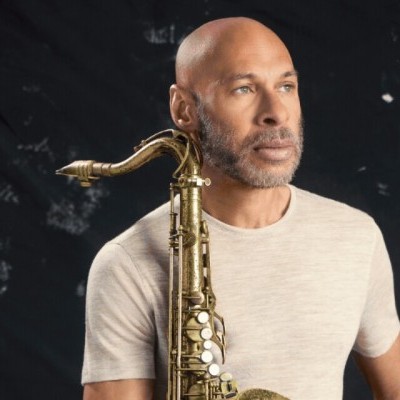
A solo concert by saxophonist Joshua Redman will close the first night of the Hyde Park Jazz Festival on Sept. 26.
Sep 22, 2026 12:26 PM
The Hyde Park Jazz Festival will take place for the 20th time on the final weekend of September 2026. Beginning half…
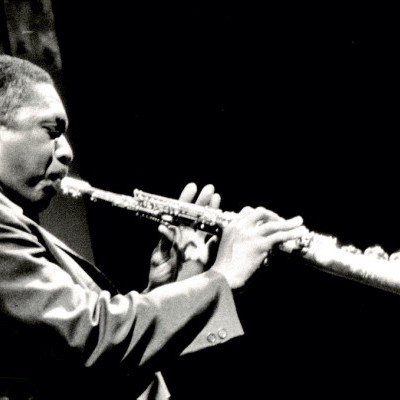
“It was just that suddenly … I could hear it,” Ravi Coltrane said of an epiphany he experienced during his late teens regarding his father’s music. “And it was almost like a calling, like something saying, ‘Hey, man, come on. It’s time to get serious.’ And the first time you really tune in and dial in and focus like that, it can be very life-changing.”
Sep 22, 2026 1:39 PM
Editor’s Note: Tomorrow, Sept. 23, is the 100th anniversary of John Coltrane’s birth. In honor of the tenor and…
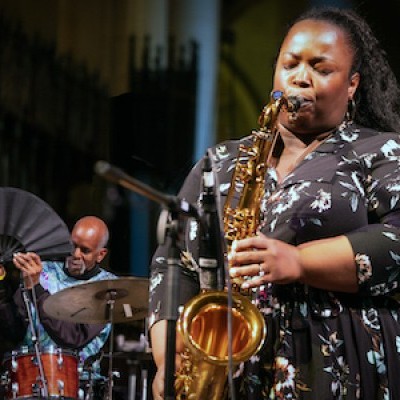
Camille Thurman took to the stage alongside bassist Kenny Davis and drummer Tommy Campbell for a rendition of Johnny Mercer’s “I’m An Old Cowhand” that recalled Rollins’ epochal 1957 trio outing Way Out West.
Oct 6, 2026 1:33 PM
As emcee Mark Ruffin noted at the commencement of an epic tribute to saxophonist Sonny Rollins at the Cathedral of Saint…
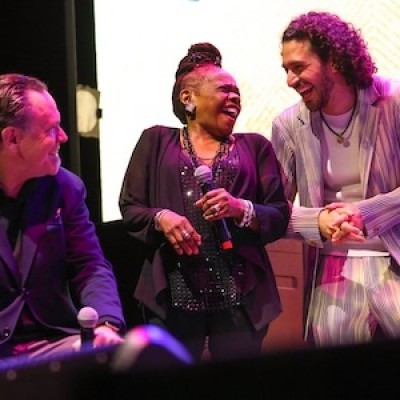
Kurt Elling, Katherine Russell and Emmet Cohen (host on the 2027 Jazz Cruise) share a laugh at sea.
Sep 8, 2026 11:52 AM
It began in 2001. A travel agent named Anita E. Berry had been booking clients on “partial” jazz cruises that took…
Sep 17, 2026 11:00 AM
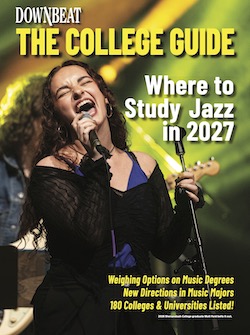
The 2027 DownBeat College Guide is an invaluable resource for music students, especially jazz students, to find a school…