Sep 22, 2026 12:26 PM
Hyde Park Jazz Fest on Chicago’s South Side to Present 20th Edition
The Hyde Park Jazz Festival will take place for the 20th time on the final weekend of September 2026. Beginning half…


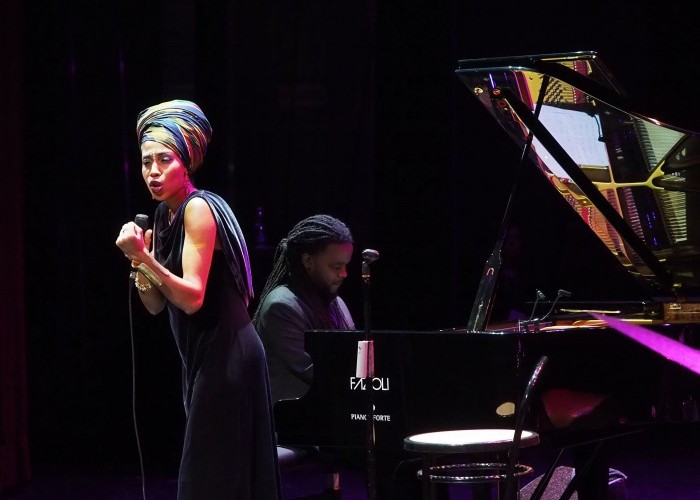
Jazzmeia Horn channeled Betty Carter and Sarah Vaughan at the Umbria Jazz festival during December.
(Photo: Courtesy Umbria Jazz)Just after twilight Dec. 28 on the ground floor of the 14th-century Palazzo del Popolo, when the last note of the opening concert of Umbria Jazz Winter’s 25th season had been played, Carlo Pagnotta, the festival’s 84-year-old president and founder, who is not easily impressed, was enthusing about a new discovery.
“Did you hear that guitar player?” Pagnotta asked expectantly. “He is fantastic.”
For emphasis, Pagnotta crooked his elbow and cupped his right hand upward, thumb pressing his index and middle fingers. “Unbelievable!”
The guitarist in question was Matteo Mancuso, 20, who’d played a crisp set of covers spanning hardbop, cool-bop, bebop and the Great American Songbook, with a sextet of Italian students and alumni of Berklee College of Music—tenor saxophonist Lorenzo Bisogno, pianist Cesare Panizzi, trumpeter Giovanni Tanburini, bassist Matteo Balcoue, and drummer Michele Tedesco, along with vocalist Davide Cerreta and others.
Bisogno, a native of Assisi, was particularly impressive at the Orvieto, Italy, showcase with a series of rhythmically perspicacious, harmonically sophisticated, melodic solos—his references seemed to include Jimmy Heath, Joshua Redman and Warne Marsh, Mark Turner and Joel Frahm—in which storytelling imperatives were paramount.
The preceding band was Chord Four, comprised of West Coast-based 30-somethings Andrew Conrad on tenor saxophone, Brandon Sherman on trumpet, Emilio Terranova on bass and Colin Woodford on drums, who have been together since 2008, and sounded like it.
Their seven original compositions coalesced a global array of rhythms and out-of-the-box structures to facilitate fresh thinking on the improvisations, which, indeed, were consistently focused and creative. Although Chord Four’s has been described as “avant-garde,” only the kaleidoscopic third piece (no title was announced) stood outside the 21st-century mainstream. After a brisk, odd-metered unison opening, Woodford blew a drone through a tubal instrument. The flow switched to a free-boppish sax-trumpet call-and-response space. Sherman—who displayed enviable control throughout the proceedings—soloed first, floating through the melody over a double-time bass vamp; after another statement of the form, he uncorked a brisk solo that evoked the raw lucidity of L.A. trumpet legend Bobby Bradford. Terranova played a virtuosic bass solo more reminiscent of Roberto Miranda than Charlie Haden. Conrad’s light-toned tenor solo, as throughout, was notable for motific phrasing and deliberate development.
A few hours later, 27-year-old rising star vocalist Jazzmeia Horn played for a packed Mancinelli Theater, a five-tiered acoustic marvel built during the 18th century. She and her band had reached town only a few hours before and hadn’t rehearsed, which may explain why their set—which followed her well-received Social Call (Prestige)—had an unfocused, meandering quality.
Horn opened with Betty Carter’s stop-start classic, “Tight,” on which she scatted at great length, as though to warm up, dialoguing with the superb young pianist Victor Gould, who signified on John Hicks’ contribution to Carter’s late 1970s bands. On “East Of The Sun,” Horn paid homage to her earliest influence, Sarah Vaughan. She started with a rather mannered statement of the lyric over a medium-slow walking bassline that transitioned into tempo, provoking Horn to render the lyric with Sarah-esque swoops and melismas that foregrounded another extended scat episode, climaxing with a harsh, strained, sardonic falsetto. Gould’s imaginative solo informed listeners that he’s checked out the procedures of modern masters like Tommy Flanagan and Kenny Barron and reached his own conclusions. Horn returned, engaging her bemused Italian audience in a call-and-response sing-along. She followed Gould’s crisp solo on Charlie Parker’s “Au Privave” with yet another extended, swinging, far-flung scat, creating interesting shapes and textures.
Just as the thought arose that Horn might lack confidence in her ability to illuminate a song’s message solely through lyric delivery, she unveiled considerable interpretative powers on the bittersweet Jimmy Rowles-Norma Winstone classic, “A Timeless Place (The Peacocks),” whose harmonic nuances and bittersweet narrative pose an ambitious subject for a 27-year-old to tackle.
She returned to deconstructive strategies on “Night and Day”: after an introductory vocalese passage, she gave way to Gould for another luminous solo that addressed melody on its own terms of engagement, then again seduced her well-heeled witnesses to acknowledge complicity with her subversive agenda, urging them to sing “I love myself” several times. She graduated to “I love my eyes, I love my nose, I love my skin” and concluded with, “No more police brutality.” She reinforced the message on a swinging “I Didn’t Know What Time It Was” (another nod to Betty Carter), concluding with “I know what time it is.” She cemented the message with “Lift Every Voice And Sing,” known colloquially as the “Black National Anthem.”
Night one of Umbria Jazz Winter’s 25th year ended with a fiery after-midnight jam session at Malandrino Bistrot, one of the dozens of fine restaurants that operate in this hilltop town of 8,000 souls. Following a supper set by a world-class trio featuring Bolognese tenor saxophonist Piero Odorici, Philadelphia-born bassist Darryl Hall and Roman drummer Roberto Gatto, Odorici joined a supportive, erudite trio comprising pianist Riccardo Biseo, bassist Massimo Moriconi and the 83-year-old Naples-born drummer Gegè Munarti, whose unerringly crisp, centered beats and imaginative postulations and responses evoked vibrations not unlike Jimmy Cobb. A one-time protégé of Cedar Walton, mentored by Steve Grossman and by Umbria Jazz co-founder Alberto Alberti during formative years, Odorici elaborated a personal style that refracted the dialects not only of Rollins, Coltrane, Shorter, Henderson, and Grossman, but George Coleman as well. After about 40 minutes, Houston-born trombonist Andre Hayward—in town for four performances with “In My Mind,” Jason Moran’s extraordinary multi-media reimagination of Thelonious Monk’s 1959 At Town Hall album—assumed the bandstand to play a poignantly soulful declamation on “Good Morning Heartache,” then locked in with Odorici on a fire-breathing “Blue and Boogie,” on which both showed their fluent, virtuosic command of the global language of jazz. DB
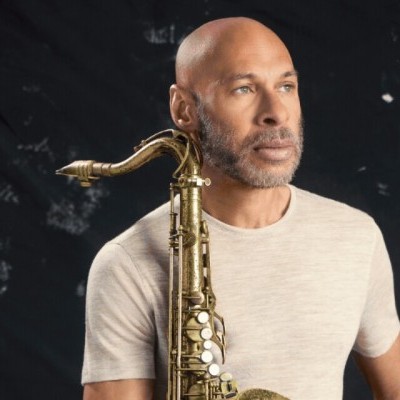
A solo concert by saxophonist Joshua Redman will close the first night of the Hyde Park Jazz Festival on Sept. 26.
Sep 22, 2026 12:26 PM
The Hyde Park Jazz Festival will take place for the 20th time on the final weekend of September 2026. Beginning half…
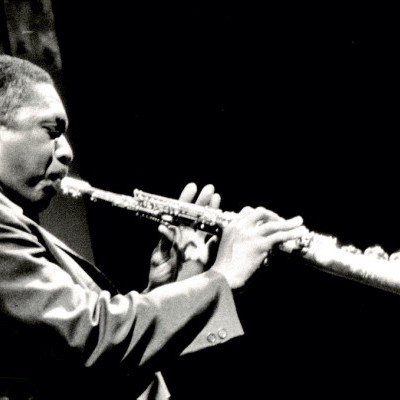
“It was just that suddenly … I could hear it,” Ravi Coltrane said of an epiphany he experienced during his late teens regarding his father’s music. “And it was almost like a calling, like something saying, ‘Hey, man, come on. It’s time to get serious.’ And the first time you really tune in and dial in and focus like that, it can be very life-changing.”
Sep 22, 2026 1:39 PM
Editor’s Note: Tomorrow, Sept. 23, is the 100th anniversary of John Coltrane’s birth. In honor of the tenor and…
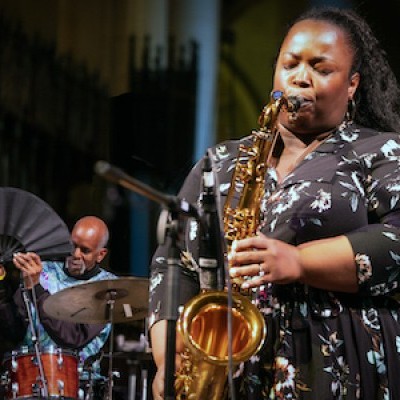
Camille Thurman took to the stage alongside bassist Kenny Davis and drummer Tommy Campbell for a rendition of Johnny Mercer’s “I’m An Old Cowhand” that recalled Rollins’ epochal 1957 trio outing Way Out West.
Oct 6, 2026 1:33 PM
As emcee Mark Ruffin noted at the commencement of an epic tribute to saxophonist Sonny Rollins at the Cathedral of Saint…
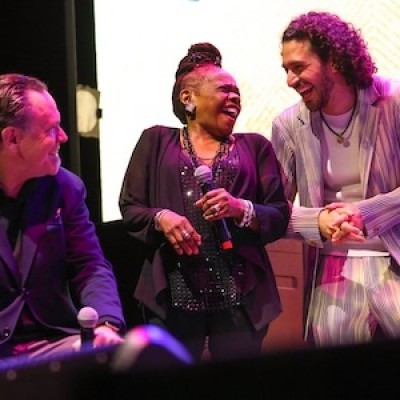
Kurt Elling, Katherine Russell and Emmet Cohen (host on the 2027 Jazz Cruise) share a laugh at sea.
Sep 8, 2026 11:52 AM
It began in 2001. A travel agent named Anita E. Berry had been booking clients on “partial” jazz cruises that took…
Sep 17, 2026 11:00 AM
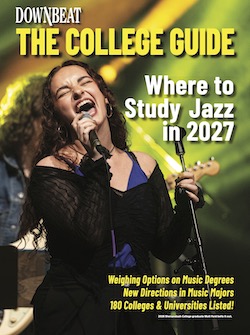
The 2027 DownBeat College Guide is an invaluable resource for music students, especially jazz students, to find a school…