Sep 22, 2026 12:26 PM
Hyde Park Jazz Fest on Chicago’s South Side to Present 20th Edition
The Hyde Park Jazz Festival will take place for the 20th time on the final weekend of September 2026. Beginning half…


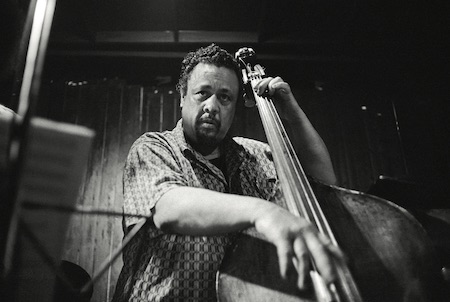
The results of Epitaph are alternately lyrical, cacophonous, raucous and elegiac.
(Photo: Jan Persson)Any consideration of Charles Mingus’ corpus must contend with Epitaph, his magnum opus, a monster orchestral work that is, like the man himself, ambitious, sprawling, ungainly, virtuosic, overstuffed, angry, passionate and restless. Consisting of 19 movements, it was written for an orchestra of 31 — in effect a double big band, augmented by bassoon, oboe, tuba, timpani, electric guitar and vibes.
The score, which exceeds 500 pages, was written over a 20-year period. It takes more than two hours to perform, and was painstakingly pieced together after his death in 1979 by musicologist Andrew Homzy, who found it in the home of Sue Mingus, Mingus’ wife. She had asked Homzy to catalogue the Mingus papers, now residing in the Library of Congress.
Ultimately unclassifiable, it can be construed as a postmodern take on traditional and modern jazz as well as European classical forms and conventions. It includes a few of his best-known works, “Better Get It In Your Soul,” “Peggy’s Blue Skylight,” and “Freedom,” throwbacks to early jazz (Jelly Roll Morton’s “Wolverine Blues”) and nods to Duke Ellington and Thleonious Monk. The work constantly confounds expectations; any time it threatens to go somewhere conventionally, it reaches for the unexpected. The results are alternately lyrical, cacophonous, raucous and elegiac.
Epitaph rose like a phoenix — eventually — from the ruins of what Mingus considered his biggest failure: his disastrous 1962 concert at New York’s Town Hall. The huge orchestra — which included Snooky Young and Clark Terry on trumpets and Eric Dolphy, Charles McPherson and Zoot Sims on saxophones, among many other greats — had been assembled but never properly rehearsed. Copyists were still madly scribbling parts even as the concert was underway. There was even disagreement between the promoters (including George Wein) and Mingus about how to describe the event: Mingus wanted a public recording session, but advertising called it a concert. At one point, according to multiple accounts, Mingus grabbed the mic and exhorted the audience to ask for its money back.
The work was later championed by Gunther Schuller, who conducted the first complete concert version at Lincoln Center in 1989 with a band that included Wynton Marsalis, Snooky Young and Randy Brecker on trumpets, and George Adams and John Handy on saxophones. Sony/Columbia released the recording as a double album the following year. Schuller oversaw another version in 2007, which played in New York, Chicago, Cleveland and Los Angeles with Christian McBride on bass.
Musicians who have performed it testify to its difficulty. Marsalis is said to have once pointed at a passage in the score, saying, “That looks like something you would find in an etude book ... under ‘hard.’”
As you might expect, the bass is often front and center. McBride, recalling the experience, said, “I didn’t get too hung up on the technical difficulty. Any passage I had problems with — well, you just have to practice harder. [But] my sense was that he didn’t want it perfect.” DB
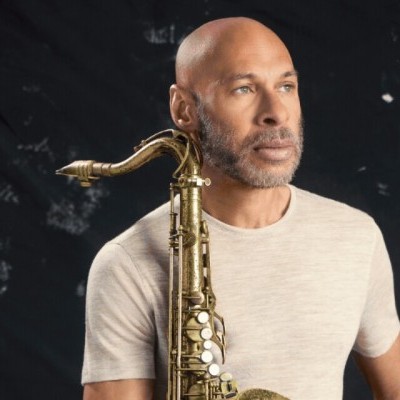
A solo concert by saxophonist Joshua Redman will close the first night of the Hyde Park Jazz Festival on Sept. 26.
Sep 22, 2026 12:26 PM
The Hyde Park Jazz Festival will take place for the 20th time on the final weekend of September 2026. Beginning half…
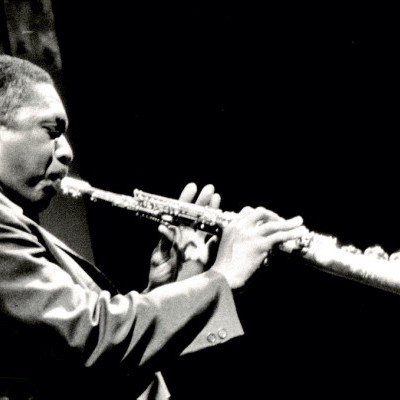
“It was just that suddenly … I could hear it,” Ravi Coltrane said of an epiphany he experienced during his late teens regarding his father’s music. “And it was almost like a calling, like something saying, ‘Hey, man, come on. It’s time to get serious.’ And the first time you really tune in and dial in and focus like that, it can be very life-changing.”
Sep 22, 2026 1:39 PM
Editor’s Note: Tomorrow, Sept. 23, is the 100th anniversary of John Coltrane’s birth. In honor of the tenor and…
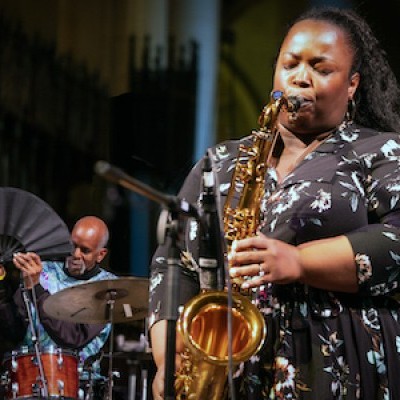
Camille Thurman took to the stage alongside bassist Kenny Davis and drummer Tommy Campbell for a rendition of Johnny Mercer’s “I’m An Old Cowhand” that recalled Rollins’ epochal 1957 trio outing Way Out West.
Oct 6, 2026 1:33 PM
As emcee Mark Ruffin noted at the commencement of an epic tribute to saxophonist Sonny Rollins at the Cathedral of Saint…
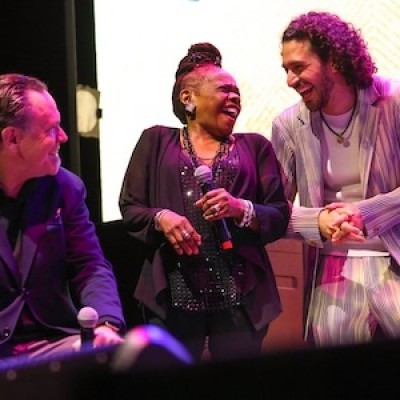
Kurt Elling, Katherine Russell and Emmet Cohen (host on the 2027 Jazz Cruise) share a laugh at sea.
Sep 8, 2026 11:52 AM
It began in 2001. A travel agent named Anita E. Berry had been booking clients on “partial” jazz cruises that took…
Sep 17, 2026 11:00 AM
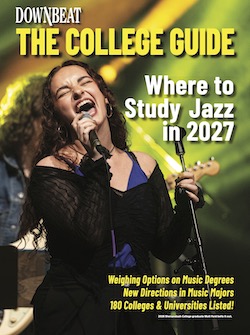
The 2027 DownBeat College Guide is an invaluable resource for music students, especially jazz students, to find a school…