Sep 22, 2026 12:26 PM
Hyde Park Jazz Fest on Chicago’s South Side to Present 20th Edition
The Hyde Park Jazz Festival will take place for the 20th time on the final weekend of September 2026. Beginning half…


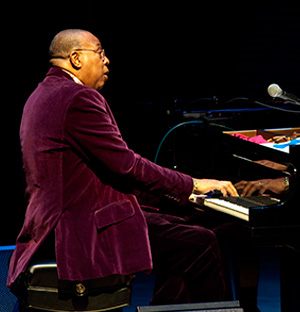
Chucho Valdés at Carnegie Hall (Photo: Fran Kaufman)
(Photo: )That was certainly the case during his Dec. 1 performance with his quintet in Zankel Hall, part of Carnegie Hall’s monthlong “Voices from Latin America” series. As he walked onto the stage, a humble giant that appeared to hover over crowd, Valdés folded his hands into prayer and bowed with gratitude before he took his seat at the piano.
“Bésame Mucho,” written by Mexican classical pianist Consuelo Velázquez, was certainly an interesting opener for the 90-minute set. Nevertheless, Valdés’ arrangement illustrated why he is considered as an icon of Latin jazz. Transitioning from the steady-handed trills of McCoy Tyner to a Bach fugue, Valdés painted a detailed picture of his musical upbringing.
The intimacy on “Pilar,” a song that Valdés wrote for his mother, came from both the contemplative music itself and the instrumentation of bass, piano and drums only with the temporary exclusion of Dreiser Durruthy Bombalé on the batá drum and Yaroldy Abreu Robles on congas. With a gentle nod to Miles Davis’ “Blue In Green,” Valdés’s melodic chords were framed around bassist Angel Gaston Joya Perellada, who opened the number with a bow in hand while drummer Rodney Yllarza Barreto provided the right amount of snare, keeping with the overall melancholy mood of the number.
DownBeat caught up with Valdés in The Maestro dressing room at Carnegie Hall before his Dec. 4 concert with three other piano greats—Danilo Pérez, Egberto Gismonti and Gonzalo Rubalcaba. (His translator was Tatiana García Altagracia.)
At what point in your life did you know that you would become a professional musician?
I started playing piano when I was 3 years old. My parents said that I was just born to play, so I just popped out and started [playing]. I started listening to my dad, Bebo Valdés, and that’s when it all just [happened]. So since childhood, I felt that I was going to be a musician. There was just something in me already—there was no other question.
During the Dec. 1 performance with your quintet, one could hear the varied influences in your playing—classical, modern jazz, African. Other than your father, who inspired you early on?
Growing up in my house, my father played a lot of genres [because] he was a very devoted musician who played at The Tropicana [Club]. In order to play at Tropicana, you had to know a lot of genres because every night has a different genre, a different style of music. Every six months, Tropicana had a theme. For instance, each time when they played Brazilian, for those six months it was all about Brazilian music. That would change, and then another six months about the blues and jazz. Milt Jackson, Buddy Rich, Billy Taylor, Roy Haynes, Sarah Vaughn, Nat King Cole—these are the people that I saw at Tropicana. So the musicians needed to know all the genres in order to accompany them. So that was a big influence. After the shows, there were these jam sessions with Cuban and American musicians which were also a part of that structure and influence. So there was jazz, samba, classical, even Spanish and Flamenco style kind of music. My father always wanted me to understand these genres and that’s how I got many, many influences at a young age. For my classical education, I studied at the Municipal Music Conservatory of Havana. The batá musician that you saw was chanting in this ancient language of the Yoruba called lucumí. The Yoruba influence of the music was because of my neighborhood and childhood.
In 1964, I had a small group and we recorded two albums. The idea was already forming in my mind of what would later become Irakere. Paquito D’Rivera was already a member. He had to be around 15 years old at the time. He was phenomenal and a prodigious child. When Paquito was 8 years old, he could already play Mozart. When we were making the group with bass player Carlos Del Puerto and percussionist Oscar Valdés, I formed a trio called Jazz Batá and composed a song called “Irakere” with the trio. It wasn’t close to forming the group—just a song back then. We played in the Cuban Modern Music Orchestra and [eventually] Carlos, Oscar and I separated from the orchestra to form Irakere. Paquito came on, and then we added conga player Tato [Alfonso], drummer Bernardo Garcia and guitarist Carlos Emilio Morales, and we formed Irakere in 1973. It was instantaneous. How I grew up and all of the influence, it was just a tribe with many possibilities. It was a time and opportunity to blend them all in. With elements of classical music that I studied at the conservatory and Santería, they combined and became this genre and it’s had much success.
Several artists have since left Irakere—yourself, D’Rivera, Arturo Sandoval—and have gone on to have successful solo careers. At the time, did you all feel that you had ample room to experiment musically?
I believe that the group achieved what it [set out] to do—creatively, especially. But I needed a change within myself, a musical change. I needed to bring out Chucho the pianist. I have developed myself as a pianist, a solo player, and I have discovered many things that I could not discover in Irakere because there were four major kinds of musicians. As a solo musician, I have had a lot of fulfillness in [tapping into] new genres and possibilities for myself.
Are there any plans for Irakere reunite in the future?
I would like to, but the original members of the group, it’s difficult because each one has their own career. As for me, it would be fantastic. —Shannon J. Effinger
A solo concert by saxophonist Joshua Redman will close the first night of the Hyde Park Jazz Festival on Sept. 26. Sep 22, 2026 12:26 PM The Hyde Park Jazz Festival will take place for the 20th time on the final weekend of September 2026. Beginning half… “It was just that suddenly … I could hear it,” Ravi Coltrane said of an epiphany he experienced during his late teens regarding his father’s music. “And it was almost like a calling, like something saying, ‘Hey, man, come on. It’s time to get serious.’ And the first time you really tune in and dial in and focus like that, it can be very life-changing.” Sep 22, 2026 1:39 PM Editor’s Note: Tomorrow, Sept. 23, is the 100th anniversary of John Coltrane’s birth. In honor of the tenor and… Camille Thurman took to the stage alongside bassist Kenny Davis and drummer Tommy Campbell for a rendition of Johnny Mercer’s “I’m An Old Cowhand” that recalled Rollins’ epochal 1957 trio outing Way Out West. Oct 6, 2026 1:33 PM As emcee Mark Ruffin noted at the commencement of an epic tribute to saxophonist Sonny Rollins at the Cathedral of Saint… Kurt Elling, Katherine Russell and Emmet Cohen (host on the 2027 Jazz Cruise) share a laugh at sea. Sep 8, 2026 11:52 AM It began in 2001. A travel agent named Anita E. Berry had been booking clients on “partial” jazz cruises that took… Sep 17, 2026 11:00 AM The 2027 DownBeat College Guide is an invaluable resource for music students, especially jazz students, to find a school…
In other news... DownBeat's Most Read Stories
Hyde Park Jazz Fest on Chicago’s South Side to Present 20th Edition
A John Coltrane Centennial
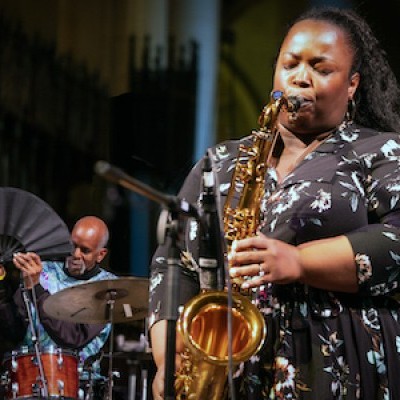
Sonny Rollins Gets an Epic Send-Off in Manhattan
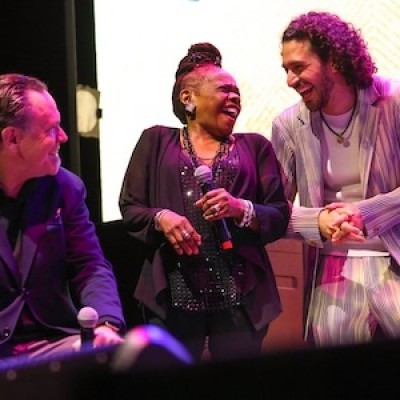
Jazz Cruises Swing at Sea

Check Out the College Guide!