Sep 22, 2026 12:26 PM
Hyde Park Jazz Fest on Chicago’s South Side to Present 20th Edition
The Hyde Park Jazz Festival will take place for the 20th time on the final weekend of September 2026. Beginning half…


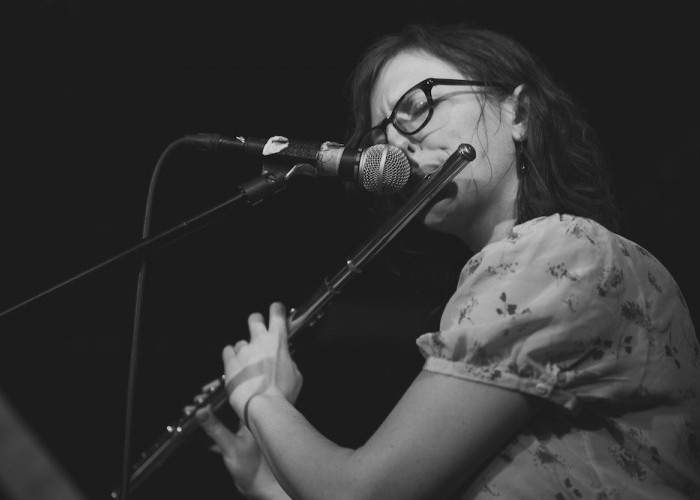
Multi-instrumentalist Anna Webber tailored her writing on Clockwise to the improvising musicians she assembled for the project.
(Photo: Evan Shay)For decades, jazz composers have struggled for the recognition and resources enjoyed by their classically oriented counterparts. But for a new generation of jazz performers, that finally might be changing.
Clockwise, a new release on Pi Recordings that features a septet led by multi-instrumentalist and composer Anna Webber, exemplifies the trend. “I think that these worlds are coming together—and specifically on the New York music scene, it’s a really exciting time where people from New Music and jazz are interested in what each other are doing,” the bandleader said.
Her Clockwise project was conceived with seven pioneering improvisers in mind: herself and Jeremy Viner on woodwinds, Jacob Garchik on trombone, Christopher Hoffman on cello, Matt Mitchell on piano, Chris Tordini on bass and Ches Smith on drums.
Drawing from 20th-century compositional languages of Iannis Xenakis, Milton Babbit and John Cage—specifically, their work for percussion—Webber’s approach offers an Ellingtonian flair that aims to stimulate the imaginations of each musician.
“I wanted to see what everybody else was capable of and really tailor my writing to those specific people—and not just to ‘the trombone’ or ‘the cello,’ but actually to Jacob Garchik or Christopher Hoffman,” she explained. “So, I met with everybody and just asked, ‘OK, show me a bunch of the weird sounds that you know how to do. ... [A]nd then let’s improvise together, so I can get some more ideas through that, and see what kind of blends are possible.’”
Through interactions with New Music composers, Webber’s learned to perceive the innovations of improvising musicians in a new light.
“Many New Music composers want to write saxophone stuff that’s like Evan Parker,” she observed. “It’s a super-complex way of getting to what Evan Parker is doing—obviously in a very studied and thoughtful way. But it’s not like he’s writing it down as an 11-over-9 polyrhythm.”
This led her to a new passion for translating musical improvisers’ intuition into the written language of Western composition.
“We have all this facility as improvisers to do everything that everybody else is doing—in fact, they’re trying to write down what we’re doing. But we’re not writing it down,” she said. “So, why don’t we write it down?”
Clockwise is her answer to the question, a delightfully quirky album that brings the strange virtuosity of extended techniques into the space of collective creativity. The notation guide for “Kore II” instructs the trombonist to “make a thwacking sound with tongue on mouthpiece”; “Idiom II” features an eerie microtonal tenor saxophone duet that uses a venting technique to alter pitches.
Drawing on the language of classical composition has its perks. It helped provide for Webber’s four-week residency at the MacDowell Artist Colony in Peterborough, New Hampshire. That monthlong stay gave her the space do to the meticulous, painful work of actually producing the scores.
“I had done all the research, I had met with everybody, I had done all my research on the instruments, I knew all the people,” she said. “And then that was the last step: OK, lock myself in a room—in this case, a beautiful room in the woods with my lunch being delivered every day.”
Webber is quick to insist that she’s far from the first person to explore the interconnections of these seemingly disparate musics, evidenced in part by the Pulitzer Prize awards given to improviser-composers Ornette Coleman and Henry Threadgill.
“I feel like most musicians that I know don’t stratify their music listening according to genre,” Webber said. “A lot of what interests me as a composer, generally, is stuff that is important to classical composition—in a way that is different than a lot of jazz writing.”
Clockwise, being drawn from the creative milieu of New York’s music scene, where boundaries among styles rapidly are breaking down, might just offer a blueprint for a subsequent generation to build bridges spanning these musical worlds. DB
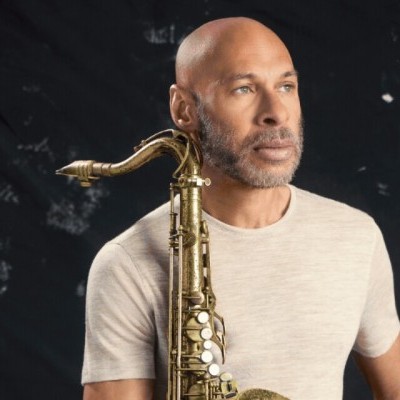
A solo concert by saxophonist Joshua Redman will close the first night of the Hyde Park Jazz Festival on Sept. 26.
Sep 22, 2026 12:26 PM
The Hyde Park Jazz Festival will take place for the 20th time on the final weekend of September 2026. Beginning half…
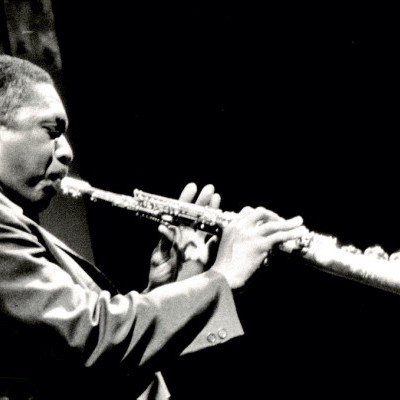
“It was just that suddenly … I could hear it,” Ravi Coltrane said of an epiphany he experienced during his late teens regarding his father’s music. “And it was almost like a calling, like something saying, ‘Hey, man, come on. It’s time to get serious.’ And the first time you really tune in and dial in and focus like that, it can be very life-changing.”
Sep 22, 2026 1:39 PM
Editor’s Note: Tomorrow, Sept. 23, is the 100th anniversary of John Coltrane’s birth. In honor of the tenor and…
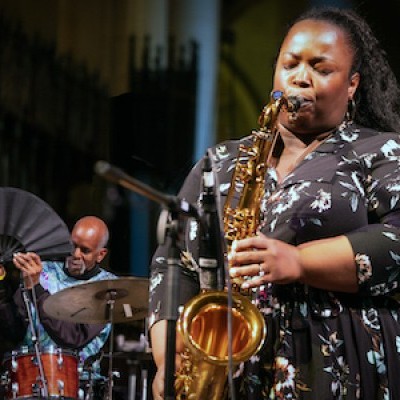
Camille Thurman took to the stage alongside bassist Kenny Davis and drummer Tommy Campbell for a rendition of Johnny Mercer’s “I’m An Old Cowhand” that recalled Rollins’ epochal 1957 trio outing Way Out West.
Oct 6, 2026 1:33 PM
As emcee Mark Ruffin noted at the commencement of an epic tribute to saxophonist Sonny Rollins at the Cathedral of Saint…
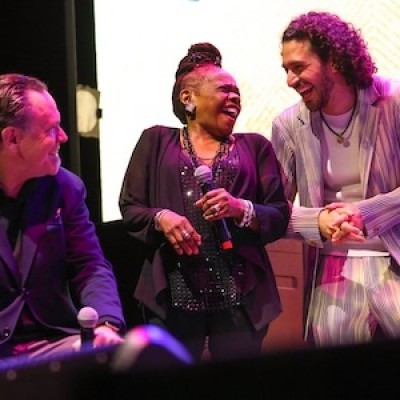
Kurt Elling, Katherine Russell and Emmet Cohen (host on the 2027 Jazz Cruise) share a laugh at sea.
Sep 8, 2026 11:52 AM
It began in 2001. A travel agent named Anita E. Berry had been booking clients on “partial” jazz cruises that took…
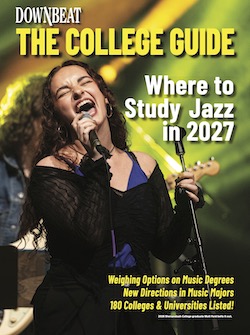
Sep 17, 2026 11:00 AM
The 2027 DownBeat College Guide is an invaluable resource for music students, especially jazz students, to find a school…